




Tuesday, August 5, 2025–12:45 p.m.
-David Crowder, WRGA News-

Rome City and Floyd County Commissioners were unable to come to an agreement regarding the distribution of proceeds from a floating local option sales tax as part of House Bill 581 on Tuesday, possibly putting a November referendum in jeopardy.
As part of the legislation, local governments can hold a referendum where voters will decide whether or not to implement a one-penny sales tax, with the proceeds going to offset property taxes.
Floyd County Manager Jamie McCord presented a proposal that would see the county get 75 percent and the city get 25 percent, arguing that since city residents pay both city and county property taxes, they would see a dollar for dollar benefit while county taxpayers would see a 75 cent on the dollar benefit.
“A city resident, regardless of the split, is going to receive the same reduction on their tax bill–If it’s 100 percent or if it’s zero percent for the city,” he said. “The same amount of money is going to come off the tax bill based on what is collected. All city residents pay county taxes. All county residents pay county taxes. So, if it’s 100 percent for the city or zero percent for the city, your bill is going to be reduced by the same amount because you get a collective tax bill.”
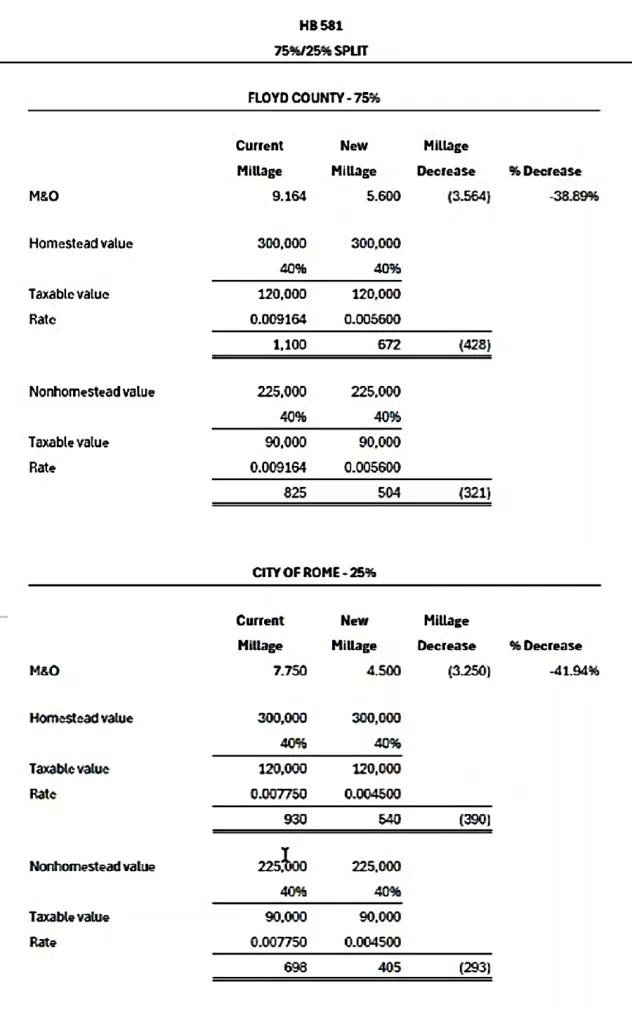
However, Rome City Manager Sammy Rich presented a proposed split with the county getting 60 percent and the city receiving 40 percent, which is closer to the current local option sales tax split and is based more on population.
“Looking at the 2020 Census, when we look at the percentages, the roughly 38.25 percent of the population of the county,” he said. “When we talk about the digest—if you add up all of the properties for the net digest, what’s the value inside the city, proportionally, to the total count? It’s 39 percent. So, roughly about 40 percent of the total value is what makes up all of these properties and all of these values. The city makes up about 40 percent.”

However, the county did not budge from the 75/25 split, and the meeting ended with no agreement.
“We’ve wavered twice,” McCord said. “Sammy and I have had these discussions, so this isn’t the first time we’ve talked about it. It’s the first time ya’ll [commissioners] have talked about it with us.”
“Well, we appreciate you buying us breakfast,” Mayor Craig McDaniel replied as the meeting came to a close.
According to Assistant County Attorney Chris Jackson, it would have been his preference to get an agreement on Tuesday so they could get the referendum on the ballot inside the 90 days required for a General Election, which is November 5.
However, there are two other options,
“You can hold it as a totally separate and apart election,” Jackson said. “That would mean you would essentially have to have double the staff and double the cost. Or you could wait until the next possible Election Day, which would shorten the benefit of next year’s collections.”
If the referendum does not go on the November ballot, the next possible date is in May of 2026.
If the referendum is held in November, collections of the penny tax would start in January. There would be a year of collections to roll back the millage rates in 2027.
If the referendum is not held until May, property owners would only get six months of tax relief on their 2027 property tax bills.
